
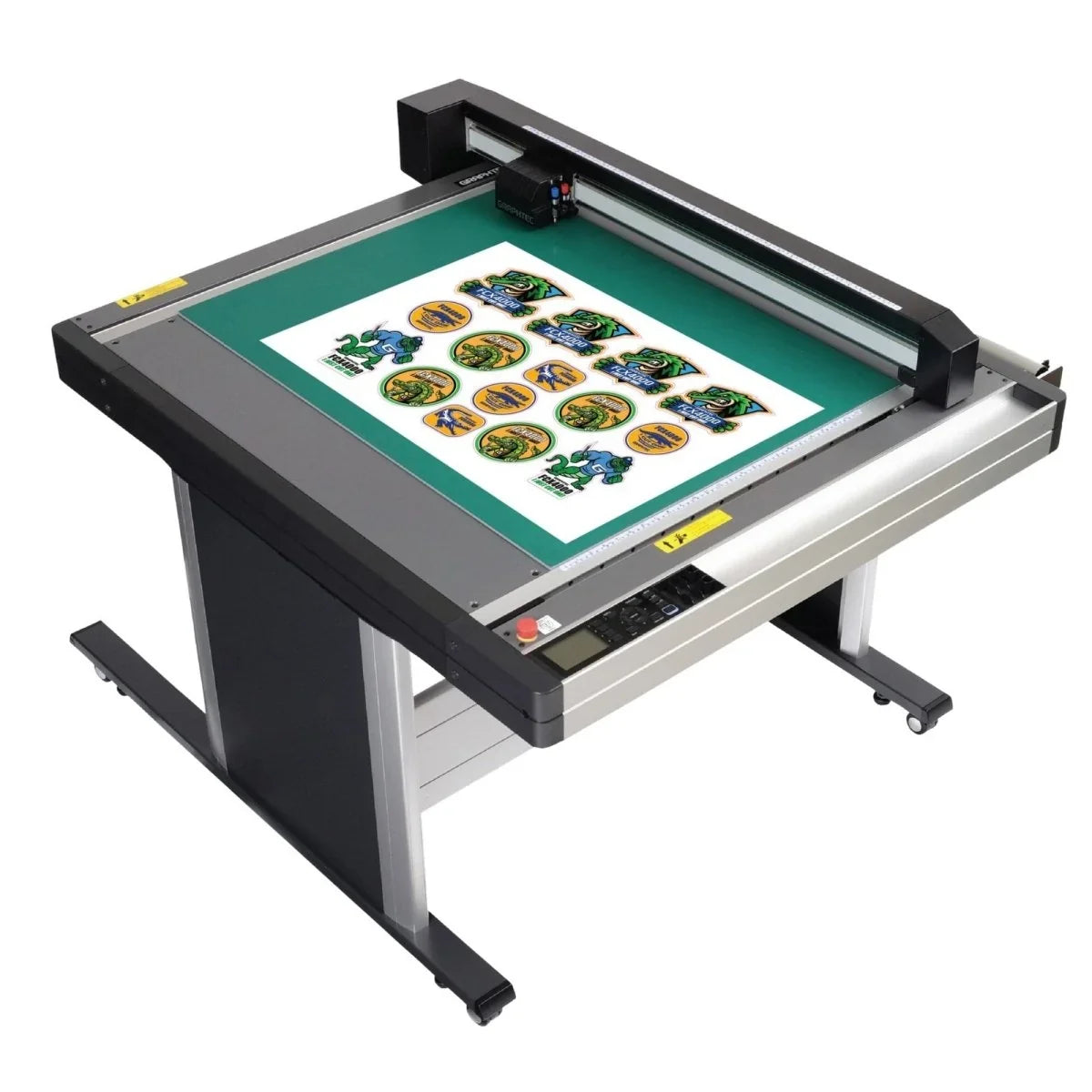

Most shops meet a flatbed cutter for one job — usually a customer asking for a folding carton mock-up, or a run of decals that a roll cutter keeps stretching. Then the machine sits there and quietly absorbs half a dozen other jobs the shop used to send out. Below are the eight jobs flatbeds actually earn their keep on, what each one needs in tooling, and — just as usefully — the work these machines are the wrong tool for.
Application 01 · Packaging
Folding cartons, corrugated prototypes and structural samples
This is the job that sells most flatbeds. A client wants to see the box before committing to a steel rule die — and a die costs money and takes days. On a flatbed you cut and crease the sample in one job, fold it, and hand it over the same afternoon. If the structure is wrong you change the file and cut another.
The part that matters is creasing, not cutting. Anybody can cut a carton outline; the difference between a sample that folds like the real thing and one that cracks along the fold is the crease. A dual-head machine holds the blade in one head and a creasing wheel or rod in the other, so cut and crease happen in the same pass with the sheet never moving. That registration is why the folds line up.
WHAT IT TAKES: A 3 mm blade (CB30UC or PM-CB-001) for the cut, and the right creasing tool for the board — rod type for heavy paper, roller type for cardboard, a wider roller for fluted board. Get the crease tool wrong and you either emboss the surface or crush the flute. On E flute expect around 1.5 mm of cut capacity; on F and G flute, about 1.2 mm.
Application 02 · Signage & graphics
Contour-cutting printed sheets without the stretch
A roll-fed cutter grips media between pinch rollers and drives it back and forth. On a long job, on thin or warm laminate, that media walks — and by the far end of a print the contour cut has drifted off the artwork. A flatbed doesn't move the media at all. The sheet is held flat and the head does the travelling.
Registration mark sensing closes the loop. The machine reads the marks printed alongside the artwork and compensates for skew and scale, so a laminated print that came out of the press half a percent long still gets cut on the line. Four-point compensation handles sheets that are off in both axes.
WHAT IT TAKES: A 0.9 mm 45° blade (CB09UB) for standard cast and calendered vinyl up to about 0.25 mm. If you're kiss-cutting, the depth setting matters more than the blade — set it to part the face stock and score the liner, and check it on a scrap corner every time you change material batch.

The media stays still and the head moves — the whole reason contour accuracy holds up across a full sheet.
Application 03 · Glass, stone & awards
Sandblast resist stencils
Monument work, architectural glass, etched awards and glassware all start with a rubber resist stencil. Sandblast rubber is thick, dense and springy — it fights the blade the whole way, and a roll cutter's 500 gf of downforce usually isn't enough to part it cleanly in one pass.
This is where a machine with a heavier second tool earns its money. A 1 kgf head gets through 1 mm resist without multi-passing, and a flat vacuum bed stops the rubber lifting and dragging as the blade turns corners. For memorial work — long runs of small, tight lettering — that difference shows up as clean serifs instead of torn ones.
WHAT IT TAKES: CB15U-K20 for sandblast resist rubber to 1 mm, or PM-CB-001 for plain rubber sheet up to 2 mm. Run the steepest blade angle the material allows — a 60° blade holds its line through tight radii far better than a 45° in dense rubber.
Application 04 · Industrial
Gaskets, seals, shims and insulation parts
A surprising amount of flatbed work has nothing to do with print. Machine shops, HVAC fabricators and electronics assemblers cut gaskets from rubber sheet, cork and closed-cell foam; insulation and thermal pads get cut to shape; polycarbonate and PET film get cut into shims and insulating washers.
The economics are the point. A one-off gasket that would take a week and a tooling charge from a die house takes twenty minutes on a flatbed from a DXF file — and the second one costs nothing but material. Maintenance departments that discover this tend to keep the machine busy.
WHAT IT TAKES: PM-CB-001 for rubber to 2 mm, CB15U-K30 for compressed foam sheet to about 0.8 mm, CB15U for clear sheet and polycarbonate to 0.5 mm (CB15U-K30 up to 1 mm). A cling mat helps enormously on small parts — without it the finished piece lifts on the last corner and the blade drags it.
Application 05 · Apparel & textiles
Heat transfer film, appliqué and DTF transfer trimming
Garment decorators use flatbeds for heat transfer vinyl, flock and appliqué shapes, and increasingly for trimming and separating printed DTF transfers into individual gang-sheet pieces. Cutting HTV on a flatbed rather than a roll cutter means you can lay a whole sheet down, cut everything on it, and weed once — no unrolling, no re-registering.
For appliqué and multi-layer designs, a stationary sheet also means every layer indexes to the same origin. Layer registration on garment work is where roll-fed setups lose time.
WHAT IT TAKES: CB09UB at 45° covers most HTV. For thin, delicate films where a 45° blade over-penetrates, drop to a 30° blade (CB09UB-K60) — the shallower angle is the same trick window-tint installers use.
Application 06 · Traffic & safety
Reflective sheeting for signs, plates and safety markings
High-intensity and diamond-grade reflective sheeting is abrasive by design — the retroreflective layer is glass beads or prismatic optics, and it eats ordinary blades. Shops doing traffic signage, emergency vehicle markings or safety decals go through blades fast unless they're running the right one.
Reflective work is also unforgiving on registration: legends, borders and legend spacing on a regulatory sign have specified tolerances, and a stationary sheet with mark sensing is a far more reliable way to hit them than a roll cutter tracking a long print.
WHAT IT TAKES: CB15UA — the blade specified for high-intensity reflective film — at 45° for material to 0.5 mm, or CB15UA-K30 at 60° up to 1 mm. Buying these in five-packs rather than twos is worth it if reflective is regular work; they are consumables on this material, not spares.
Application 07 · Labels & stickers
Kiss-cut sheets and short-run die-cut labels
Sticker sheets, product labels, seals and short-run die-cut packs are steady work for print shops, and they're a natural flatbed job: print a sheet, register it, kiss-cut the shapes, and hand over a sheet the customer peels from. Barcode-driven job loading matters here more than anywhere else — scan the code printed on the sheet and the machine pulls the matching cut file, so an operator running twelve different sticker jobs in a morning never picks the wrong one.
Full-cut die shapes work the same way, with a protect sheet or cutting mat under the stock to take the blade strike.
WHAT IT TAKES: CB09UB and careful depth calibration. Budget for protect sheets and cling mats as running costs — the sheet under the stock is the consumable that keeps the bed itself undamaged.
Application 08 · Templates & marking
Pattern work, pouncing and drawn layout
Swap the blade for a pen holder and the machine becomes a plotter again. Shops use this for sewing and upholstery patterns, layout lines on board before assembly, drill-point marking, and pounce patterns for hand-lettering and wall graphics. It's the least glamorous use and one of the most quietly useful — anything you'd otherwise mark out by hand with a straightedge.
WHAT IT TAKES: A pen holder and pressurized ball point pens, or a holder that takes a standard Sharpie if you want a heavier line. For pounce patterns, a pouncing tool with a steel pin.
What a flatbed cutter is not for
Worth saying plainly, because it saves a bad purchase. A flatbed cutting plotter drives a small blade with a few hundred grams to a kilogram of downforce. That is a different machine from a router or an oscillating-knife table.
It will not cut rigid substrates — ACM, acrylic, 3 mm and 5 mm foam board, PVC sheet, plywood. It will not cut thick corrugated beyond roughly 1.5 mm, and it will not do heavy production die-cutting at volume, where a steel rule die remains cheaper per piece past a few hundred units. If the job list is mostly rigid board, you want a router or a knife table, and we'd rather tell you that now than after the crate is open.
Matching the blade to the material
Most cut-quality complaints trace back to the wrong blade rather than the wrong machine. This is the working reference for a Graphtec FCX-series flatbed:
| Material | Max thickness | Blade |
| Self-adhesive vinyl, fluorescent & reflective film | 0.25 mm | CB09UB |
| Heavy paper & oil board | 0.5 mm | CB15U, CB15U-K30 |
| Heavy paper & oil board, thick | 1.0 mm | CB30UC |
| Compressed foam sheet | 0.8 mm | CB15U-K30 |
| Sandblast resist rubber | 1.0 mm | CB15U-K20 |
| Cardboard, E flute | 1.5 mm | CB30UC |
| Cardboard, F/G flute | 1.2 mm | CB30UC cut / CB15U-K30 crease |
| Rubber sheet | 2.0 mm | PM-CB-001 |
| Clear sheet & polycarbonate | 0.5 mm / 1.0 mm | CB15U / CB15U-K30 |
| High-intensity reflective film | 0.5 mm / 1.0 mm | CB15UA / CB15UA-K30 |
Figures per Graphtec's published FCX4000 media chart. Always check the user manual for your specific model before running a new material.

Hold-down is half the cut quality — small parts that lift on the last corner get dragged by the blade.
Vacuum or electrostatic — which hold-down suits your shop
Everything above depends on the sheet staying put, and there are two ways to do that.
Electrostatic holds the media with a charged panel. No pump, no compressor, no three-phase supply — it plugs into a standard 110 V outlet and is quiet enough to sit in an office or at the front of a print shop. That's the Graphtec FCX4000 series, from $9,995 — best suited to samples, short runs, labels and decal work on beds up to 38.4" × 25.9".
Vacuum pulls the sheet down through a perforated bed and holds far more aggressively across a much larger area — which is what you need for wide sheets, dense rubber and production volume. That's the Graphtec FCX2000 series, from $14,500, in cutting widths to 70.8" with a 1 kgf second tool. It needs a pump and the floor space to go with it.
Both carry two tools at once, both read registration marks, and both run offline from a USB stick with no computer attached.
If you're weighing one of these up, the fastest way to a straight answer is to tell us the material, the thickest thing you cut and your sheet size — we'll tell you which machine handles it, which blade it needs, and whether a flatbed is the right tool at all. Browse the full range of flatbed cutters and Graphtec blades, holders and creasing tools, or email sales@allprintheads.com.

Printheads, cutters and printer spare parts for wide-format, textile, label and industrial machines.
www.allprintheads.com
