
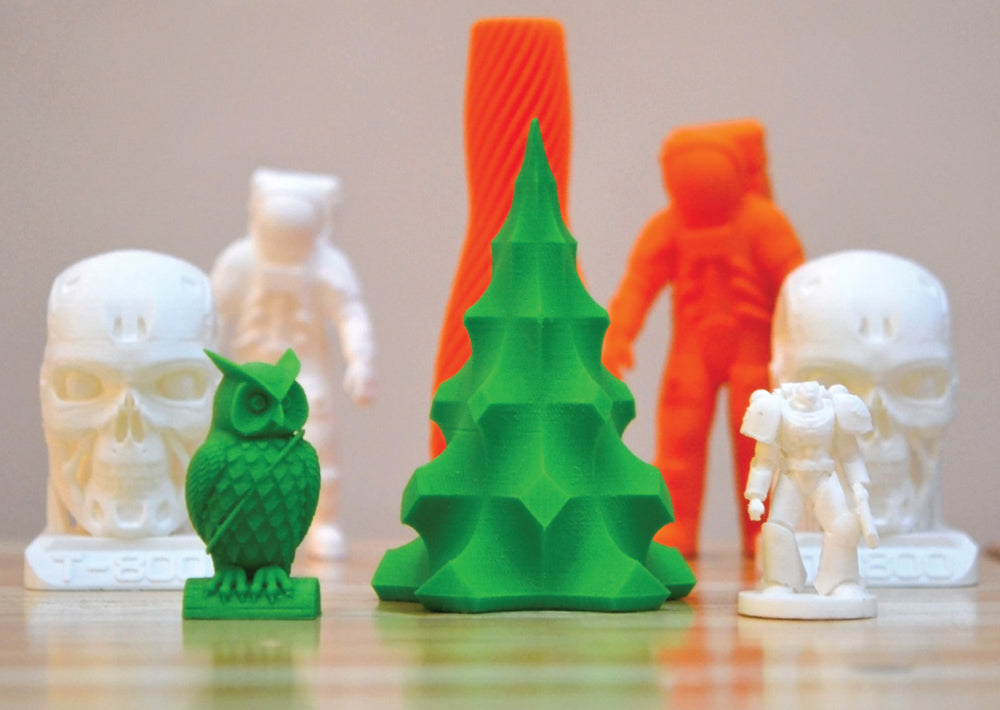
The sign industry has seen its fair share of technological upheaval. For example, after several centuries of brush and spraying work, the 1990’s arrival of vinyl cutters and easy-to-use sign software allowed virtually anyone to become a signmaker. Soon after, digital printing machines and photo editing software transformed the monochrome world of vinyl cutting into the vibrantly colored digital print world we know today. So, is 3D printing the newest wave to hit the sign industry? Is it industry-altering technology?
Most 3D printers are fairly simple machines. Essentially, they comprise an XY carriage, a Z platform, and a printhead. The printhead can be a heated nozzle that extrudes melted plastic or a laser that can either solidify liquid resin or fuse powdered metal into a finished part. The XY carriage positions the head and a drop of plastic or a laser burst are emitted. The Z platform lowers for the next pass as the part is built up. Printer prices range from a few hundred bucks up to six figures, and they are cool – but the question remains: What good is 3D printing to a sign shop? Before exploring that question, let’s look at the workflow for producing a 3D object via a printer that works with plastic filament. Our imagined job is a sign that requires a dimensional version of the client’s logo. The client has provided high-quality logo artwork that you scan and transfer into an X, Y and Z program that converts the 2D artwork into commands that form a 3D object. With the artwork converted into a 3D printable format (typically .stl), the file moves to software (commonly called a slicer) that prepares and sends a print code to the deposition stage, which will convert the build material (machine type designated) into slice commands that the printer tracks and layers, one material layer on top of the other.
This action builds up the printed object. Once the layering process is in action, you can sit back and relax (or, do your normal job) because some machines take hours to complete a print. Processing time depends on the material, resolution and your choice of selected fill. Once finished, the part may need sanding and painting to finish.
Does this seem like a lot of work? That depends on many things – machine type, object size, and required finishing – but the real question is will it add significantly value to the sign?
DRAWBACKS
In addition to time, another detrimental aspect is, presently, the finishing step for 3D objects that can be more time-consuming, but printers exist that can produce objects in full color. This class of printers, especially those with extra features, is costly, but if the prints add significant value to your finished signs (think investment cost, time and market demand), then one could be worth the investment.
Another limitation is object size. A low-priced but effective printer may be able to produce an 8-cubic-in. The object and you can segment designs into parts and assemble them, but such fabrication adds more time and complexity. If you are willing to invest the money, large-format printers are available that produce objects up to 7-ft. high, but expect to invest heavily in such a system. Still, we are seeing a few signmakers explore the market. Another consideration is that your 3D a printer may be used to create dimensional logos, lettering or symbols, as well as to produce the hardware commonly used to make signs: Handles, hinges, and legs for A-frames are examples. Also, enclosures for electronics and wiring harnesses and other coverings can be fabricated.
Back to our original question – will 3D printing work in the sign shop? We believe it will eventually arrive in force, but for now, there are a few pieces missing. While vast 3D libraries exist today (see thingiverse.com) sign-specific 3D clipart libraries need to be created. In addition, mounting hardware companies could license 3D fabrication libraries so that shipping times and customization can be minimized. Our summary is that printing 3D objects takes significant skills and time, which can be costly, but ready-made designs and more intuitive software will ultimately get signmakers involved.
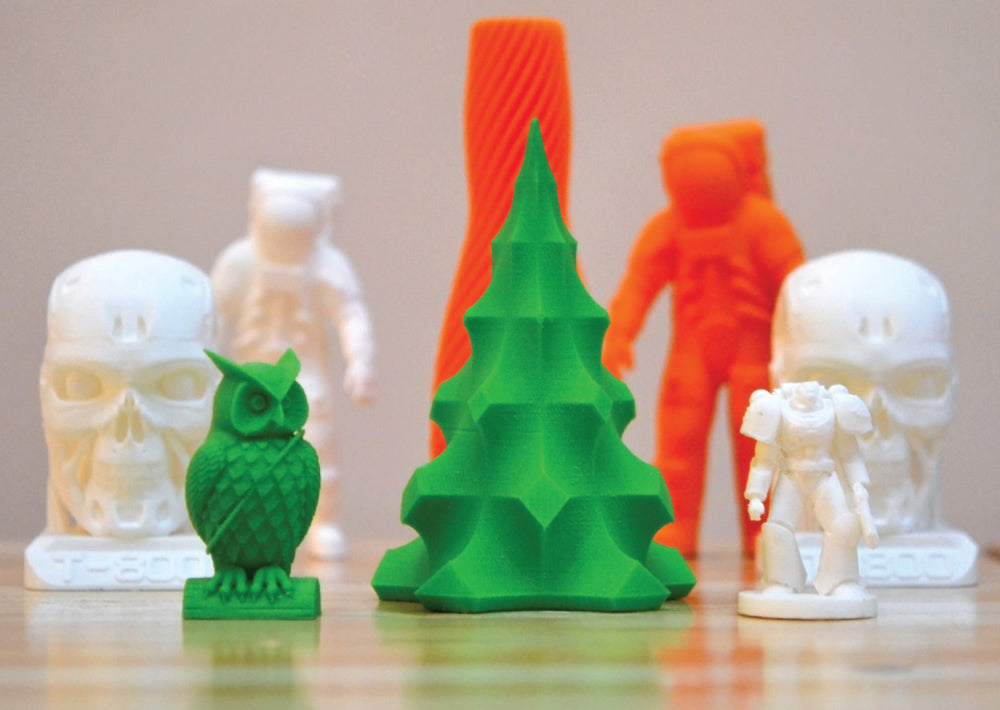
Some Solutions you may use for your shop, are :
- FLASHFORGE FINDER 3D PRINTER

- FLASHFORGE INVENTOR II 3D PRINTER

- FLASHFORGE CREATOR PRO-DUAL EXTRUSION

- FLASHFORGE GUIDER II S

- FLASHFORGE HUNTER DLP RESIN

- FLASHFORGE DREAMER DUAL EXTRUSION

The article is taken from the Signs of The Times. August 2018 Edition.

1 comment
Sören Stolze
3D-Druck im Schildergeschäft: Sind Signshops bereit für additive Fertigung?
Die Zeichen- und Werbebranche hat in den letzten Jahrzehnten immer wieder technologische Umwälzungen erlebt – von Schneideplottern über Digitaldruck bis hin zu modernen Bildbearbeitungslösungen. Heute stellt sich die Frage, ob 3D-Druck die nächste transformative Technologie für Schilder- und Werbebetriebe ist.
3D-Drucker arbeiten im Kern über das Schichten von Material, sei es Kunststoff, Harz oder Metall. Für Signshops bedeutet dies die Möglichkeit, Logos, Schriftzüge, Symbole oder sogar Hardwarekomponenten wie Griffe, Scharniere und A-Rahmen individuell zu fertigen. Der Workflow umfasst die Umwandlung digitaler Grafiken in 3D-Modelle (.stl), das Slicen dieser Modelle und den eigentlichen Druckprozess. Je nach Material, Auflösung und Füllung kann ein Druckvorgang mehrere Stunden dauern, und oft sind Nachbearbeitungsschritte wie Schleifen oder Lackieren notwendig.
Herausforderungen:
Zeitaufwand & Endbearbeitung: 3D-gedruckte Teile benötigen Zeit und teilweise umfangreiche Nachbearbeitung. Farbige oder hochkomplexe Objekte erfordern teurere Maschinen.
Objektgröße: Standarddrucker sind meist klein, für Großformate (>1 m) sind teure Industrieanlagen notwendig.
Fachwissen: 3D-Druck erfordert Kenntnisse in 3D-Modellierung, Slicing-Software und Materialkunde.
Chancen:
Maßgeschneiderte Logos und Beschriftungen auf Abruf
Produktion individueller Hardware für Schilder (Griffe, Halterungen, Gehäuse)
Zukünftige Nutzung von 3D-Bibliotheken für signenspezifische Vorlagen, um den Workflow zu beschleunigen
Fazit:
3D-Druck bietet für Signshops langfristig enormes Potenzial, ist aber derzeit noch mit Investitionen, Zeitaufwand und Fachwissen verbunden. Mit zunehmender Verfügbarkeit von intuitiver Software, fertigen Designs und größeren 3D-Druckbibliotheken wird die Technologie in den kommenden Jahren wohl fester Bestandteil in Werbe- und Schilderbetrieben.
Für praxisnahe Beispiele und Beratung zu industriellen 3D-Drucklösungen, einschließlich FDM-, DLP- und Harztechnologien, besuchen Sie ATC-3D
.